園冶杯大學(xué)生國際競賽管理辦法
園冶杯大學(xué)生國際競賽管理辦法
Management Measures on YUANYE AWARDS for Students
一、總 則
I.General Principles
1.為促進學(xué)生的創(chuàng)新意識及設(shè)計水平、加強國際學(xué)術(shù)交流、促進學(xué)科發(fā)展,特組織舉辦園冶杯大學(xué)生國際競賽并制定本細則。
1.To enhance students' innovative awareness and design capabilities, strengthen international academic exchanges, and promote disciplinary development, YUANYE AWARDS International Competition for Students is organized, and these detailed rules are formulated accordingly.
2.園冶杯大學(xué)生國際競賽是由全球相關(guān)高校和相關(guān)行業(yè)組織自愿發(fā)起的固定的年度競賽。
2.YUANYE AWARDS for Students is a fixed annual event voluntarily initiated by relevant universities and industry organizations worldwide.
3、園冶杯國際競賽由國際設(shè)計師協(xié)會主辦,國際自然資源學(xué)會協(xié)辦的全球大學(xué)生專業(yè)賽事。
園冶杯國際競賽組委會由發(fā)起高校和國際設(shè)計師協(xié)會、國際自然資源學(xué)會、以及協(xié)辦單位的有關(guān)人員組成,組委會秘書處設(shè)在園冶杯城市設(shè)計中心,具體負責(zé)大賽的組織實施工作。
3.Sponsored by GDA(Global Designers Association) and co-organized by iAONR (International Association of Natural Resources), this competition is a professional event for college students globally.
YUANYE AWARDS Organizing Committee consists of representatives from initiating universities, GDA, iAONR, and co-organizing units. The Secretariat of the Organizing Committee is located at the YUANYE AWARDS Urban Design Center, which is specifically responsible for the organization and implementation of the competition.
4.園冶杯大學(xué)生國際競賽每年開展一次,秉承自愿申報的原則。
YUANYE AWARDS for Students is held once a year, adhering to the principle of voluntary application.
5.園冶杯大學(xué)生國際競賽評選采用線上、線下評選相結(jié)合的方式進行。
5.The evaluation of the competition adopts a combination of online and offline assessment methods.
二、參賽對象
II. Eligible Participants
任何國家和地區(qū)的相關(guān)專業(yè)院校,包括但不限于建筑、城鄉(xiāng)規(guī)劃、園林園藝、土木工程、公共藝術(shù)、室內(nèi)設(shè)計、產(chǎn)品設(shè)計、環(huán)境藝術(shù)設(shè)計、資源與環(huán)境等專業(yè),均可參加。
Relevant professional colleges and universities from any country or region are eligible to participate, including but not limited to majors such as Architecture, Urban and Rural Planning, Landscape Architecture, Civil Engineering, Public Art, Interior Design, Product Design, Environmental Art Design, and Resources and Environment.
三、競賽類別
III. Competition Categories
分為畢業(yè)設(shè)計(畢業(yè)論文)、主題競賽、課程設(shè)計等類別。
The competition is divided into three categories: Graduation Design (Thesis), Thematic Competition, and Course Design.
(一)畢業(yè)設(shè)計(畢業(yè)論文)
1.畢業(yè)設(shè)計:城鄉(xiāng)規(guī)劃(城市設(shè)計)、建筑設(shè)計、風(fēng)景園林、藝術(shù)設(shè)計(室內(nèi)設(shè)計、產(chǎn)品設(shè)計、公共藝術(shù)、環(huán)境藝術(shù))。
2.畢業(yè)論文:城鄉(xiāng)規(guī)劃、土木建筑、風(fēng)景園林(風(fēng)景園林、園林)、資源環(huán)境(地理資源、生態(tài)修復(fù)、林業(yè)草原、景觀生態(tài))。
(I) Graduation Design (Thesis)
Graduation Design: Urban and Rural Planning (Urban Design), Architectural Design, Landscape Architecture, Art Design (Interior Design, Product Design, Public Art, Environmental Art).
Graduation Thesis: Urban and Rural Planning, Civil Engineering and Architecture, Landscape Architecture (Landscape Architecture, Gardening), Resources and Environment (Geographical Resources, Ecological Restoration, Forestry and Grassland, Landscape Ecology).
(二)課程設(shè)計
城鄉(xiāng)規(guī)劃、建筑設(shè)計、風(fēng)景園林、藝術(shù)設(shè)計(室內(nèi)設(shè)計、公共藝術(shù)、產(chǎn)品設(shè)計、環(huán)境藝術(shù))
(II) Course Design
Urban and Rural Planning, Architectural Design, Landscape Architecture, Art Design (Interior Design, Public Art, Product Design, Environmental Art).
(三)主題競賽
主題競賽參考下列選題(如有變化請關(guān)注年度競賽通知)。
(III) Thematic Competition
The thematic competition refers to the following topics (please refer to the annual competition notice for updates).
1.氣候韌性。在應(yīng)對氣候變化、碳減排協(xié)同、城市韌性等設(shè)計理念和方式。包含海綿社區(qū)、綠色園區(qū),城市韌性、低碳建筑、河湖生態(tài)整治、防災(zāi)避難、災(zāi)后恢復(fù)、綠色基礎(chǔ)設(shè)施等。
1.Climate Resilience: Design concepts and methods for addressing climate change, synergizing carbon emission reduction, and enhancing urban resilience. Including sponge communities, green parks, urban resilience, low-carbon buildings, ecological improvement of rivers and lakes, disaster prevention and shelter, post-disaster recovery, green infrastructure, etc.
2.生態(tài)修復(fù)。在生態(tài)完整性修復(fù)(植被恢復(fù)、水土保持、動物棲息地連通)、生物多樣性、民生關(guān)聯(lián)性(生態(tài)產(chǎn)品轉(zhuǎn)化)等;包括:濕地、礦山、海岸帶修復(fù)、生物廊道、棕地修復(fù)、鹽堿地修復(fù)、荒漠化治理、水環(huán)境、防護林等。
2.Ecological Restoration: Focusing on ecological integrity restoration (vegetation restoration, soil and water conservation, wildlife habitat connectivity), biodiversity, and people's livelihood relevance (ecological product conversion); including wetland, mine, and coastal zone restoration, biological corridors, brownfield remediation, saline-alkali land improvement, desertification control, water environment management, shelterbelts, etc.
3.全齡友好。關(guān)注用有溫度的設(shè)計和機制,打破隔閡,讓城市、 社區(qū)中的每個成員(無論老幼病弱孕)都能平等、便利、有尊嚴地參 與和使用。 包括:全齡友好社區(qū)、公共空間;兒童友好空間、無障礙公園、跨代際共享場所(康養(yǎng)+托幼)等。
3.Age-Friendly Design: Emphasizing warm designs and mechanisms to break down barriers, enabling every member of the city and community (regardless of age, illness, disability, or pregnancy) to participate in and use public spaces equally, conveniently, and with dignity. Including age-friendly communities and public spaces; child-friendly spaces, barrier-free parks, intergenerational shared venues (elderly care + childcare), etc.
4.文化復(fù)興。關(guān)注遺產(chǎn)傳承、活化共生、文化創(chuàng)新、新舊共生、可持續(xù)性。包括歷史街區(qū)、文化村落、工業(yè)遺產(chǎn)、建筑遺址、文化街區(qū)、非遺村落、藝術(shù)空間及文創(chuàng)轉(zhuǎn)化等。
4.Cultural Revival: Focusing on heritage inheritance, activation and symbiosis, cultural innovation, coexistence of old and new, and sustainability. Including historical districts, cultural villages, industrial heritage, architectural ruins, cultural blocks, intangible cultural heritage villages, art spaces, and cultural and creative transformation projects.
5.城市更新。關(guān)注人本煥新與可持續(xù)再生,居住、生產(chǎn)、服務(wù)復(fù)合,功能混合,注重空間優(yōu)化、功能完善、文脈賡續(xù)、品質(zhì)提升,打造宜居、韌性、智慧社區(qū)。包括:既有建筑改造利用,老舊小區(qū)整治改造,社區(qū)建設(shè),老舊街區(qū)、老舊廠區(qū),存量閑置房屋和低效用地再生利用;污染地塊安全再利用,工業(yè)產(chǎn)房轉(zhuǎn)型創(chuàng)新等。
5.Urban Renewal: Focusing on people-oriented renewal and sustainable regeneration, integration of residential, production, and service functions, functional mixing, spatial optimization, functional improvement, cultural context continuity, and quality enhancement to create livable, resilient, and smart communities. Including renovation and reuse of existing buildings, renovation of old residential districts, community construction, renewal of old blocks and factories, recycling of idle stock buildings and inefficient land; safe reuse of contaminated sites, transformation and innovation of industrial workshops, etc.
6.鄉(xiāng)村活化類。關(guān)注通過規(guī)劃建設(shè)改善人居環(huán)境,依托當(dāng)?shù)刭Y源和優(yōu)勢產(chǎn)業(yè),發(fā)展特色農(nóng)業(yè)、鄉(xiāng)村旅游等產(chǎn)業(yè),打造具有地方特色的和美鄉(xiāng)村。包括:特色小鎮(zhèn)、農(nóng)文旅綜合體、都市農(nóng)業(yè)、特色鄉(xiāng)村、以及鄉(xiāng)村閑置校舍、農(nóng)房改造、文化空間的營造,鄉(xiāng)土文化保育等。
6.Rural Activation: Focusing on improving the living environment through planning and construction, developing characteristic agriculture, rural tourism and other industries based on local resources and advantageous industries, and building beautiful villages with local characteristics. Including characteristic towns, agriculture-culture-tourism complexes, urban agriculture, characteristic villages, renovation of idle rural school buildings and farmhouses, construction of cultural spaces, and preservation of local culture.
7.數(shù)智創(chuàng)新。采用人工智能、大數(shù)據(jù)、AI 等創(chuàng)新數(shù)字技術(shù)和智慧化手段,提升公共服務(wù)的空間,突出人文關(guān)懷優(yōu)先。包括:數(shù)字社區(qū)、智慧園區(qū)、數(shù)智建筑、智慧景區(qū);AI展廳、AI建筑、AI花園等。
7.Digital and Intelligent Innovation: Adopt innovative digital technologies and intelligent methods such as artificial intelligence (AI) and big data to upgrade public service spaces, prioritizing humanistic care. Including digital communities, smart parks, digital and intelligent buildings, smart scenic spots; AI exhibition halls, AI-assisted architecture, AI-enabled gardens, etc.
四、時間安排
IV. Schedule
(一)畢業(yè)設(shè)計、畢業(yè)論文、主題競賽
報名時間:4月20日 至 2025年7月10日
資料提交:5月10日 至 2025年7月25日
網(wǎng)絡(luò)投票:8月15日 至 2025年9月15日
專家評審:8月至11月
公示公告:10至12月
頒獎以及院校巡展:11月至次年
(I) Graduation Design, Graduation Thesis, and Thematic Competition
Registration Period: April 20 to July 10
Submission Period: May 10 to July 25
Online Voting Period: August 15 to September 15
Expert Evaluation Period: August to November
Public Announcement Period: October to December
Award Ceremony and University Tour Exhibition: November to the following year
(二)課程設(shè)計
第一學(xué)期
報名時間:8月10日 至9月25日
資料提交:8月20日 至 9月30日
網(wǎng)絡(luò)投票:9月30日 至 10月30日
專家評審:10月至 11月
公示公告:11月-12月
第二學(xué)期
報名時間:1月1日 至2月10日
資料提交:1月5日 至 3月5日
網(wǎng)絡(luò)投票:3月1日 至 4月1日
專家評審:3月10至 4月30日
公示公布:5月-6月
(II) Course Design
First Semester
Registration Period: August 10 to September 25
Submission Period: August 20 to September 30
Online Voting Period: September 30 to October 30
Expert Evaluation Period: October to November
Public Announcement Period: November to December
Second Semester
Registration Period: January 1 to February 10
Submission Period: January 5 to March 5
Online Voting Period: March 1 to April 1
Expert Evaluation Period: March 10 to April 30
Public Announcement Period: May to June
五、參賽要求
V. Requirements for Entries
1.語言類別:組委會指定官方語言為中文或英文,進入終審的作品,需為中英或英文。
1.Language: The official languages designated by the Organizing Committee are Chinese or English. Works entering the final review must be submitted in both Chinese and English, or English only.
2.參賽范圍
(1)畢業(yè)設(shè)計(論文):限應(yīng)屆畢業(yè)生參賽。
(2)課程設(shè)計:本科三、四、五年級,以及研究生的課程作業(yè)均可參賽(非畢業(yè)設(shè)計作品)。
(3)主題競賽:在校學(xué)生均可參賽。
2.Eligibility by Category
(1) Graduation Design (Thesis): Limited to final-year graduates.
(2) Course Design: Coursework from third, fourth, fifth-year undergraduate students and postgraduate students (excluding graduation design works) is eligible.
(3) Thematic Competition: Open to all current students.
3.多院校可聯(lián)合參賽報名,每組聯(lián)合參賽院校不超過5所。
3.Joint participation by multiple institutions is permitted, with a maximum of 5 participating institutions per group.
4.同一作者作為主創(chuàng)只能在同一類別中參與一個小類的競賽,作為成員無限制。
4.An individual may participate as the lead creator in only one sub-category within a single competition category. There is no limit to participation as a team member.
5.禁止抄襲或過度借鑒
禁止將他人創(chuàng)作的模型、空間格局、效果圖、設(shè)計理念等部分或全部復(fù)制、粘貼,或者修改后當(dāng)做自己作品參賽。
5.Plagiarism or excessive borrowing prohibited
It is strictly forbidden to copy, paste, or modify in part or in whole others' creations—including models, spatial layouts, renderings, and design concepts—and submit them as one's own work.
六、報名方式
VI. Registration Methods
參賽報名分為集體參賽與個人參賽。
Registration is divided into group registration and individual registration.
1.集體參賽
(1)院校指定專人擔(dān)任聯(lián)絡(luò)員,負責(zé)統(tǒng)一組織本院校學(xué)生參賽、參會領(lǐng)獎等相關(guān)事宜。
(2)聯(lián)絡(luò)員需登錄園冶杯官網(wǎng)(http://yyb.yuanyebei.com/)進行注冊、登記,并完善參賽學(xué)院等相關(guān)信息。
(3)參賽學(xué)生經(jīng)指導(dǎo)老師同意后,由所在院校推薦,由到學(xué)校聯(lián)絡(luò)員統(tǒng)一登記,審核匯總參賽信息,并導(dǎo)入?yún)①惞倬W(wǎng)后臺。
(4)參賽作品主創(chuàng)人員在園冶杯官網(wǎng)進行注冊,綁定所在院校,完善指導(dǎo)老師信息,邀請團隊成員參賽。
(5)信息核實并繳費后自動生成參賽作品報名號,主創(chuàng)人員登錄參賽后臺在“作品信息”欄查看報名號,將報名號按照參賽要求在作品展板指定位置體現(xiàn)。
(6)在作品提交截止日期前,將網(wǎng)展作品(論文)在網(wǎng)站后臺上傳至網(wǎng)頁。版權(quán)聲明書(全組成員簽字)掃描件或高清照片、評審作品(論文)及巡展圖上傳云盤,并將云盤分享鏈接及提取碼提交至官網(wǎng)后臺。
1. Group Registration
(1) Each participating institution shall designate a special liaison person responsible for uniformly organizing students' participation in the competition, attendance at the award ceremony, and other related matters.
(2) The liaison person must register and complete relevant information (such as the participating college) through the official YUANYE AWARDS website (http://yyb.yuanyebei.com/).
(3) With the approval of the supervisor, students shall be recommended by their institution, uniformly registered by the institutional liaison person, whose responsibilities also include verifying and compiling participation information before importing it into the official competition website backend.
(4) The lead creator of the entry shall register on the official YUANYE AWARDS website, bind to their institution, complete the supervisor's information, and invite team members to participate.
(5) After information verification and payment, a unique registration number for the entry will be automatically generated. The lead creator can check the registration number in the "Entry Information" section by logging into the competition backend and must display it in the designated position on the entry board as required.
(6) Before the entry submission deadline, upload the online exhibition version of the work (thesis) to the website backend. Upload the scanned copy or high-definition photo of the Copyright Statement (signed by all team members), the review version of the work (thesis), and the exhibition images to a cloud drive, then submit the cloud drive sharing link and extraction code to the official website backend.
2.個人參賽
(1)個人參賽由作品主創(chuàng)人員(或組長)提議,經(jīng)本院系指導(dǎo)老師審核同意后,在園冶杯官方網(wǎng)站進行注冊報名。
(2)參賽作品主創(chuàng)人員登錄后臺,填寫參賽信息,添加指導(dǎo)老師,邀請團隊成員;若無成員,可不邀。
(3)信息核實并繳費后自動生成參賽作品報名號,主創(chuàng)人員登錄參賽后臺在“作品信息”欄查看報名號,將參賽報名號按照參賽要求在作品展板指定位置體現(xiàn)。
(4)在作品提交截止日期前,將網(wǎng)展作品(論文)在網(wǎng)站后臺上傳至網(wǎng)頁。參賽報名表、版權(quán)聲明書(全組成員簽字)掃描件或高清照片、評審作品(論文)及巡展圖上傳云盤,并將云盤分享鏈接及提取碼提交至官網(wǎng)后臺。
2. Individual Registration
(1) Individual registration shall be initiated by the lead creator (or team leader) of the entry. After being reviewed and approved by the supervisor of their department, the applicant shall register on the official YUANYE AWARDS website.
(2) The lead creator shall log into the backend, fill in the participation information, add the supervisor, and invite team members (team members are not required if there are none).
(3) After information verification and payment, a unique registration number for the entry will be automatically generated. The lead creator can check the registration number in the "Entry Information" section by logging into the competition backend and must display it in the designated position on the entry board as required.
(4) Before the entry submission deadline, upload the online exhibition version of the work (thesis) to the website backend. Upload the scanned copy or high-definition photo of the Registration Form, the Copyright Statement (signed by all team members), the review version of the work (thesis), and the exhibition images to a cloud drive, then submit the cloud drive sharing link and extraction code to the official website backend.
3.參賽報名費:
會員價,高校聯(lián)絡(luò)員統(tǒng)一組織集體參賽報名的100元/人,個人參賽報名150元/人(含國際設(shè)計師協(xié)會學(xué)生會員一年年費)。
非會員價,集體參賽報名費150元/人,個人參賽報名費200元/人。集體組織參賽的20組以上作品享報名費九折優(yōu)惠。
3. Registration Fees
CategoryFee Standard
Member Price:100 RMB per person for group registration organized by institutional liaison persons; 150 RMB per person for individual registration (including one-year student membership fee of the International Association of Designers)
Non-Member Price:150 RMB per person for group registration; 200 RMB per person for individual registration
Group Discount:A 10% discount on registration fees for groups submitting more than 20 entries
七、作品要求
VII. Requirements for Works
1.參賽作品
(1)圖紙包括總平面圖、效果圖及其他表現(xiàn)設(shè)計意圖的圖紙(剖面圖、立面圖、意向圖等)以及設(shè)計說明,比例自定。
(2)每套作品設(shè)計成2張展板,3種規(guī)格,共6張圖。根據(jù)不同用途,參賽作品必須按照以下三種規(guī)格進行設(shè)計,見下表,具體參照附件。
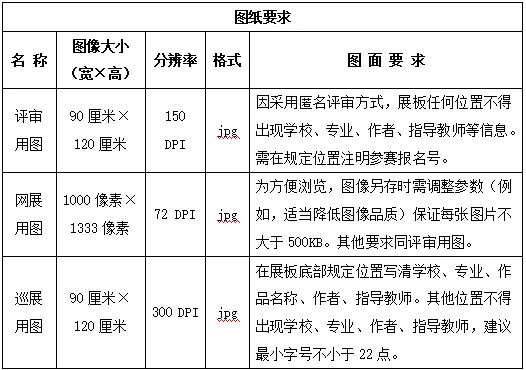
提示:官方網(wǎng)站提供的PSD模板文件未按照實際尺寸建立畫布,請學(xué)生自行按照模板樣式調(diào)整到規(guī)定尺寸。
1.Entry Specifications
(1) Drawings shall include a master plan, renderings, and other drawings that express design intentions (such as cross-sections, elevations, and concept sketches), along with a design description. The scale is to be determined by the participant.
(2) Each set of works shall be designed as 2 display boards in 3 different specifications, totaling 6 drawings. For different usage scenarios, entries must be designed in accordance with the following three specifications (see table below), with specific requirements referring to the appendix.
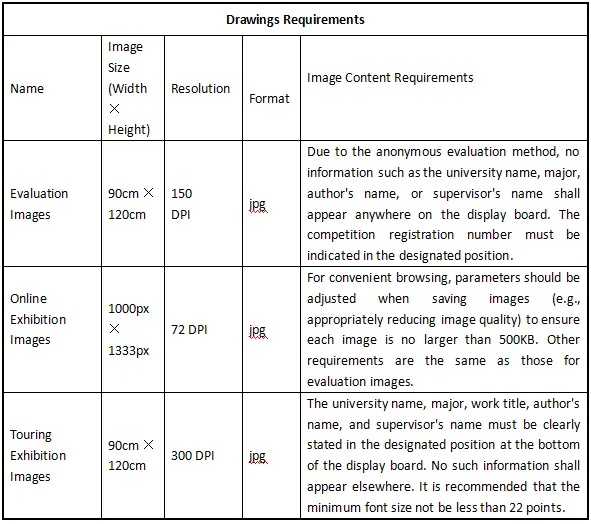
Note: The PSD template files provided on the official website are not created with actual dimensions. Participants must adjust the canvas to the specified sizes while following the template style.
2. 參賽論文
(1)參賽論文3000-5000字。
(2)參賽的論文要具學(xué)術(shù)論文的科學(xué)性和實用性,論點明確,資料可靠,文字精煉,層次清楚,數(shù)據(jù)準確。
(3)格式要求
論文應(yīng)依次包含論文題目(中英)、摘要(中英)、關(guān)鍵詞(中英)、目錄、正文、參考文獻以及必要的附錄等(不能包含“致謝”)。
文稿中不得出現(xiàn)任何反映作者身份的信息(不允許包含院校名、指導(dǎo)老師名等信息),否則取消參賽資格。
(4)提交格式
每篇論文需提交Word和PDF兩種格式的全文,詳見下表。
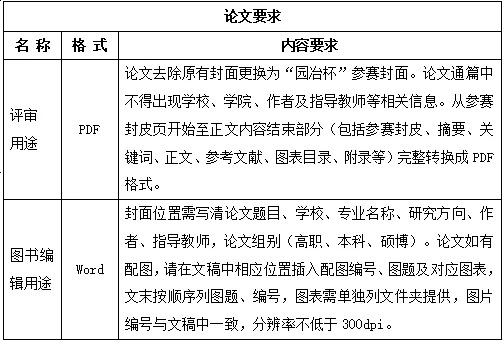
提示:在作品截止日期前必須上傳評審用途PDF版,出版用途的Word版可以在作品截止后的20個工作日內(nèi)提交。
3.參賽資料的著作權(quán)歸參賽者所有,如有糾紛作者自負,園冶杯國際競賽組委會擁有出版權(quán)和使用權(quán),參賽相關(guān)資料不予退還。請參賽者妥善保存參賽原始資料,以備出版之用。
2.Thesis Submission Requirements
(1) The word count of the submitted thesis shall be 3,000 to 5,000 words.
(2) The thesis must possess the scientific rigor and practical value of an academic paper, with clear arguments, reliable data, concise expression, logical structure, and accurate figures.
(3) Format Requirements
The thesis shall include, in sequence: Title (Chinese and English), Abstract (Chinese and English), Keywords (Chinese and English), Table of Contents, Main Text, References, and necessary Appendices (the "Acknowledgements" section is not allowed).
No information reflecting the author's identity shall appear in the manuscript (including but not limited to the name of the institution, supervisor, etc.). Violations will result in disqualification.
(4) Submission Format
Each thesis must be submitted in both Word and PDF formats. For detailed specifications, see the table below.
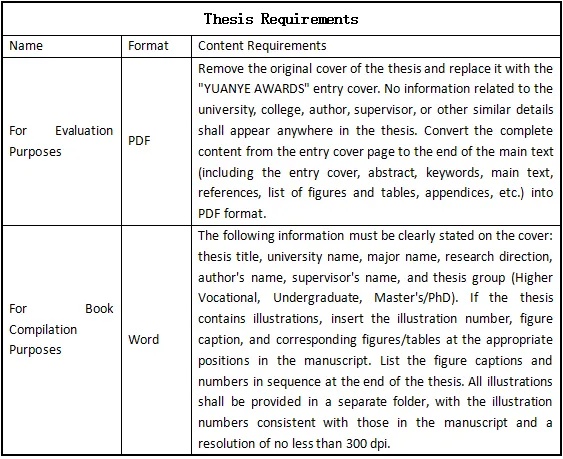
Note: The PDF version for evaluation purposes must be uploaded before the submission deadline. The Word version for publication may be submitted within 20 working days after the deadline.
The copyright of the submitted materials shall belong to the participants. Participants shall be solely responsible for any disputes arising therefrom. YUANYE AWARDS Organizing Committee shall hold the right of publication and use. All submitted materials will not be returned. Participants are advised to keep the original copies of their entries properly for potential publication.
八、評審
VIII. Evaluation
1.評審委員會
評委會由特邀的國際著名專家學(xué)者、設(shè)計師以及園冶杯成員單位推薦的學(xué)科帶頭人組成。評委會設(shè)主席、副主席、委員和成員。
1.Evaluation Committee
The Evaluation Committee consists of invited internationally renowned experts, scholars, designers, and academic leaders recommended by YUANYE AWARDS member institutions. The committee includes a Chairman, Vice-Chairmen, and members.
2.評審流程
(1) 分類分組評審
參賽作品分為城鄉(xiāng)規(guī)劃、建筑學(xué)、風(fēng)景園林、藝術(shù)設(shè)計等類別分組進行評審。評審過程全部采取盲評的方式進行。
(2) 初審
初審采取網(wǎng)評的方式,按照類別分為高職組、本科組、碩博組由評委網(wǎng)評打分,評出優(yōu)秀獎候選作品和提名作品,并予以公示。
(3)終審
終審按照評委打分和專家評議,評出一、二、三等獎的候選作品,并予以公示。
國際設(shè)計師協(xié)會學(xué)生會員的候選作品,可直接入圍國際設(shè)計師協(xié)會大學(xué)生獎的評審。
(4)結(jié)果公布
按照評委會的評審結(jié)果、公示反饋的意見以及院校核實信息的情況等,產(chǎn)生一、二、三等獎、優(yōu)秀獎最終名單。
最佳人氣獎依據(jù)網(wǎng)絡(luò)投票結(jié)果產(chǎn)生。
2.Evaluation Process
(1)Categorized and Grouped Evaluation
Entries are evaluated in groups based on categories such as Urban and Rural Planning, Architecture, Landscape Architecture, and Art Design. The entire evaluation process is conducted blindly (double-blind review).
(2)Preliminary Evaluation
The preliminary evaluation is carried out online. Entries are divided into Higher Vocational College Group, Undergraduate Group, and Master's/PhD Group by category, with judges scoring online. Shortlisted works for Excellence Awards and Nomination Awards are selected and publicly announced.
(3)Final Evaluation
Based on judges' scores and expert deliberations, shortlisted works for First, Second, and Third Prizes are selected and publicly announced.Shortlisted works by student members of the International Association of Designers are directly eligible for the evaluation of the International Association of Designers' University Student Award.
(4)Result Announcement
The final list of First, Second, Third, and Excellence Awards is determined based on the Evaluation Committee's results, feedback from the public announcement period, and information verification by participating institutions.The Most Popular Award is selected based on online voting results.
九、獎勵
IX. Awards and Incentives
1.獲獎師生優(yōu)先安排年度園冶高峰論壇演講,分享獲獎作品理念。
1.Winning teachers and students will be given priority to deliver speeches at the annual YUANYE Summit Forum to share the concepts of their award-winning works.
2.對獲獎主要作品在園冶高峰論壇及園冶講壇等活動期間組織進行巡展。
2.Key award-winning works will be featured in touring exhibitions during events such as the YUANYE Summit Forum and YUANYE Lecture Series.
3.舉辦園冶杯年度頒獎盛典,為獲獎師生頒發(fā)獲獎證書、獎杯,并在頒獎盛典的現(xiàn)場頒發(fā)獎金、獎品。
3.An annual YUANYE AWARDS Award Ceremony will be held, where winning teachers and students will be presented with certificates of merit, trophies, as well as cash prizes and physical awards on-site.
4.根據(jù)各參賽院校的組織參賽情況以及選送作品(論文)獲獎情況等綜合產(chǎn)生“優(yōu)秀組織獎”和“先進教育集體獎”;獲得優(yōu)秀組織獎的單位和聯(lián)絡(luò)員,可以直接申請為國際設(shè)計師協(xié)會學(xué)生分會的會員單位和個人會員。獲得“先進教育集體獎”的高校,可以直接申請為國際設(shè)計師協(xié)會教育分會的會員單位,主要負責(zé)人為分會理事。
4."Outstanding Organization Award" and "Advanced Educational Collective Award" will be comprehensively selected based on participating institutions' organization efforts and the award-winning performance of their submitted works (theses). Institutions and liaison persons receiving the "Outstanding Organization Award" can directly apply for membership in the Student Branch of GDA (as institutional members and individual members respectively). Universities winning the "Advanced Educational Collective Award" can directly apply for membership in the Education Branch of GDA, with their principal responsible persons serving as branch directors.
5.一、二等獎獲獎作品(論文)的指導(dǎo)教師獲選為“優(yōu)秀指導(dǎo)教師”。一、二等獎的指導(dǎo)老師可以直接申請為國際設(shè)計師協(xié)會學(xué)生分會的理事,三等獎的指導(dǎo)老師為學(xué)生分會個人會員。
5.Advisors of first and second prize-winning works (theses) will be named "Outstanding Advisors". Advisors of first and second prize winners can directly apply for the position of director in the Student Branch of the International Association of Designers, while advisors of third prize winners will be granted individual membership in the Student Branch.
6.對承辦評審會暨“園冶講壇”的院校以及贊助單位頒發(fā)“杰出貢獻獎”,對設(shè)立“園冶獎學(xué)金”的單位頒發(fā)“社會責(zé)任獎”。
6.Institutions hosting the evaluation meeting and YUANYE Lecture Series as well as sponsoring units will be awarded the "Outstanding Contribution Award". Units establishing the "YUANYE Scholarship" will be presented with the "Social Responsibility Award".
7.組織獲獎作品編輯出版。
7.Award-winning works will be compiled and published.
8.組織國內(nèi)外相關(guān)院校和機構(gòu)開展獲獎作品巡展活動,各高校擬承辦巡展活動的請與組委會秘書處聯(lián)系。
8.Touring exhibitions of award-winning works will be organized in relevant universities and institutions at home and abroad. Universities interested in hosting a touring exhibition are invited to contact the Secretariat of the Organizing Committee.
9.對評審成果在園冶杯官方網(wǎng)站上開展專題報道,在微信公眾號、今日頭條號等新媒體進行全面推廣。
9.Special reports on the evaluation results will be featured on the official YUANYE AWARDS website, with comprehensive promotion across new media platforms such as WeChat Official Account and Toutiao.
十、聯(lián)系方式
X. Contact Information
官方網(wǎng)站:www.yuanyebei.com
郵箱:yyb@m.81fl.com
聯(lián)系電話:010-88360800;
參賽學(xué)生QQ群:
高校聯(lián)絡(luò)員QQ群:255900300
官方微信公眾號:園冶杯組委會
Official Website: www.yuanyebei.com
Email: yyb@m.81fl.com
Tel: 010 - 88360800
QQ Group for Participating Students:
QQ Group for University Liaison Officers: 255900300
WeChat Official Account: YUANYEAWARDS
編輯:liqing
相關(guān)閱讀
北京:永定河畔將添活力藝術(shù)休閑水岸
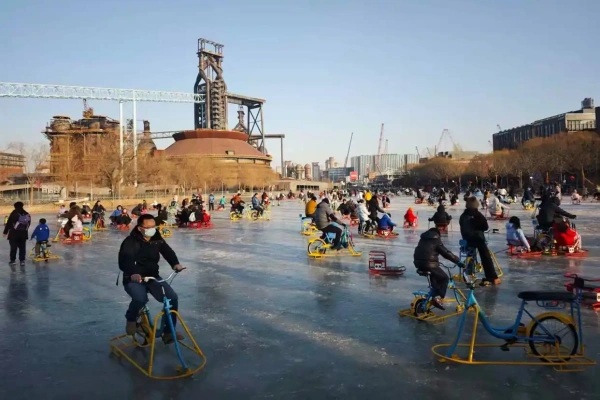
記者近日從石景山區(qū)了解到,2026年全區(qū)將統(tǒng)籌實施新一輪京西行動計劃和“兩園一河”(石景山段)工作方案,謀劃實施藝術(shù)水岸、蓮石湖水上運動休閑基地等項目,精心打造“兩園一河”水岸客廳,加快建設(shè)永定河活力片區(qū)【詳細】
航文旅商融合 打造高品質(zhì)人文機場新空間
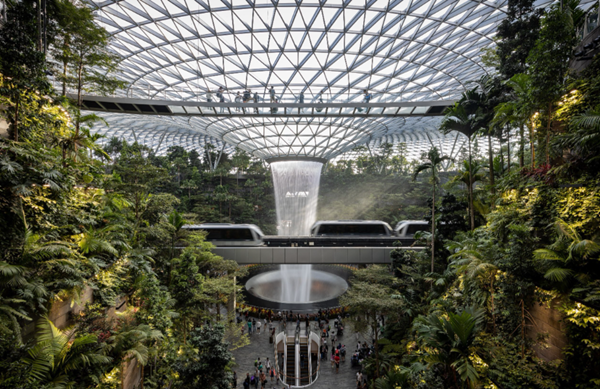
隨著民航業(yè)邁入以體驗經(jīng)濟為特征的發(fā)展新階段,機場的功能定位正經(jīng)歷深刻變革,其角色已超越傳統(tǒng)的出行中轉(zhuǎn)樞紐,加速向集高效通行、文化體驗與商業(yè)消費于一體的城市文化地標和綜合性服務(wù)平臺轉(zhuǎn)型【詳細】

一枚獎?wù)碌姆至浚簢H自然資源與規(guī)劃范例獎的故事
當(dāng)一座廢棄的礦山重新披上綠裝,當(dāng)一條渾濁的河流再現(xiàn)魚翔淺底的生機,當(dāng)一片老舊城區(qū)在更新中煥發(fā)綠色活力……這些發(fā)生在世界各地的真實改變,有一個共同的見證者與推動者:國際自然資源與規(guī)劃范例獎【詳細】

北京發(fā)布政策激勵“工具箱”為城市更新再提速
1月1日,針對城市更新實踐中的堵點難點問題,北京發(fā)布并實施《北京市城市更新政策激勵工具箱(1.0版)》(以下簡稱《政策激勵工具箱》),加大政策激勵力度,進一步激發(fā)市場活力【詳細】
熱門推薦RECOMMEND
- 園冶杯大學(xué)生國際競賽管理辦法
- 關(guān)于組織開展第五屆鄉(xiāng)村振興國際聯(lián)合畢業(yè)設(shè)計的通知
- 關(guān)于開展第十七屆園冶杯大學(xué)生國際競賽活動的通知
- 第十六屆園冶杯公共景觀獎評審結(jié)果公告
- 第十六屆園冶杯住區(qū)景觀獎評審結(jié)果公告
- 北京擬增加9家園林為第二批歷史名園
- 第十六屆園冶杯公共景觀獎評審結(jié)果公示
- 第十六屆園冶杯大學(xué)生國際競賽參賽作品投訴核查及處理結(jié)果公告...
- 關(guān)于表彰第十六屆園冶杯大學(xué)生國際競賽優(yōu)秀聯(lián)絡(luò)員的通知
- 第十六屆園冶杯大學(xué)生國際競賽先進教育集體名單